

First AI Summer
The Summer I Turned (Pretty Much) to AI for Summer Slide

It is exactly Day 2 of summer and I am already panicking about summer slide.
I’ve been lucky enough to be called a parent for 23 years now. For most of them, summer has meant I’m suddenly in charge of developing my most precious assets. Figuratively, of course. Anyone who’s raised a teenager knows they are many things, but a cheap one is not among them. I love this part of the job. It’s also hard, and it gets harder as they get older. How simple it was back when I could buy a couple of those Summer Bridge workbooks and pretend we were about to enrich ourselves with culture and meaning for several uninterrupted weeks.
At the end of every summer, those workbooks were still 75% empty.
There was enrichment. Just a different kind. The kind where you take a road trip and stumble onto a derby race in Dunsmuir, homemade go-karts with actual shoes for brakes. The kind where you ship them off to a week of camp in the mountains and they come home having learned the meaning of belonging so deeply that the only tattoo my oldest has, to this day, is that camp’s logo.
So before I launch into how useful AI can be for something like summer slide, the idea that kids regress and forget everything the second school lets out, let me say this plainly. After 23 years, I believe the unscripted stuff is often what they learn from the most. Experiences matter. Build a summer around them and one day you’ll look back, quietly taking credit for something you didn’t really cause but at least made room for.
Okay. Now that that’s on the record.
Our oldest is 23. Our youngest is 14. There is a world of difference between how my 23-year-old spent her summers and how my 14-year-old is about to spend his. Life feels more competitive now, more tilted toward excelling, more everything. It’s hard not to feel behind if you’re not doing all the things the neighbors are doing. At first that stressed me out. Then I started thinking about what AI has actually unlocked, and the stress turned into something closer to excitement.
So let me make the important point, and I’ll only shout it once.
THIS IS THE FIRST SUMMER WHERE AI HAS BEEN THIS GOOD.
The first one. The first summer the tools can see what your kid points a camera at, build a working thing from a single sentence, talk back in real time, and remember who your kid is from one week to the next. Last summer, none of that really worked. This summer, all of it does. It’ll get better, I have no doubt. But for most families, this is the starting line.
I’m calling it First AI Summer. Not the summer AI does your kid’s homework. The summer it finally does enough that you can build a whole season around it.
If you’ve been around this industry long enough, “AI summer” used to mean something else entirely, a boom period when the funding and the hype surged, the opposite of an “AI winter” when nobody could get a check signed. That kind of AI summer was for people in suits chasing valuations. This one’s for your actual kid, home from school with nothing to do and a basketball he won’t put down.
This year, I did not buy the workbooks that would only sit there blank, judging me by August. This year I’m trying something else.
For some people, that’s offensive. They balk at the idea, certain that kids today can’t think for themselves, that they’re all cheating, that they’re getting dumber by the prompt. No ma’am. I don’t buy it. More than ever, the power to make something real is sitting right there at everyone’s fingertips, and the kids who learn to actually use it are not the ones getting dumber.
I’m not naive about the rest of it. There are real conversations to be had about the environment, about policy, about who gets access and who doesn’t, and I don’t want to wave any of that away. But for my family, this summer, I want my soon-to-be freshman to walk into ninth grade with some working AI literacy. His school banned AI outright last year, which I understand, and honestly a lot of his learning was beautifully hands-on because of it. Still. We’d be kidding ourselves to think anyone can just opt out of this.
My dad tried. For years he was proud of being a Luddite, no phone, no computer, a genuine point of honor. What it actually meant was that my stepmom carried the phone, knew her way around a computer, and quietly ran every part of his life that required either one. That was how he “survived” without technology. Opting out isn’t really opting out. Someone just opts in for you.
There’s a real counterculture among kids right now that sees AI as uncool. Vaguely embarrassing, even. The sort of thing out-of-touch adults get excited about. And look, on most fronts I happily accept that my dance moves and my music taste are deeply uncool. But young Padawan, not on this one. On this one it very much behooves you to sit up and pay attention.
My son’s experience with AI so far is basically ChatGPT and math homework. He used the tutor mode, I nagged him to understand the concepts instead of just snatching answers, and I think he mostly did. He’s a good kid. But that’s about the extent of it, and that’s not going to be enough. He graduates in 2030, the same year a lot of very smart people think we’ll see something close to artificial general intelligence (AGI), AI that’s genuinely good at most things without being told exactly what to do. That year has been sitting heavy on me like nothing has since Y2K. At least Y2K had the decency to come with consulting gigs.
He can’t walk across that stage with no real fluency in the thing waiting for him on the other side. He just can’t.
So I did what I do with almost everything now, unashamedly, because it is literally my niche. I asked Claude.
Hey Claude, I said. I need something for my kid to do this summer besides gaming and basketball. No big trips planned. We’ll be in Tahoe, so there’s mountains and camping and the lake and plenty of outdoor everything, which matters to me enormously. But help me get creative. This is the first real summer of capable AI. What have you got.
After a lot of back and forth, we landed on something together. First we figured out what was actually new this summer. We decided last year’s AI couldn’t really see, couldn’t really build, couldn’t really talk back, and couldn’t really remember. Those four became the filter for every idea. It Talks Back. It Can See. It Builds. It Remembers. If a dictionary, a worksheet, a search bar, or a YouTube video could already do it, we threw it out.
Then we figured out what I was actually trying to teach him, and this is where AI made me rethink the whole thing. After 23 years I figured I had the parenting part down. I don’t. With AI, I don't think parenting or really anything will ever feel fully set again. I’ve made my peace with that, because it’s an evolutionary process now. Forever. The ground moves too fast to stand still on it for long. The more I sat with that, the more excited I got. With AI, we are all probably in an eternal state of learning and progressing. How magical is that?
So out went the Math, English, Reading plan I thought I was going to build.
And in came life.
The Summer AI Card Set
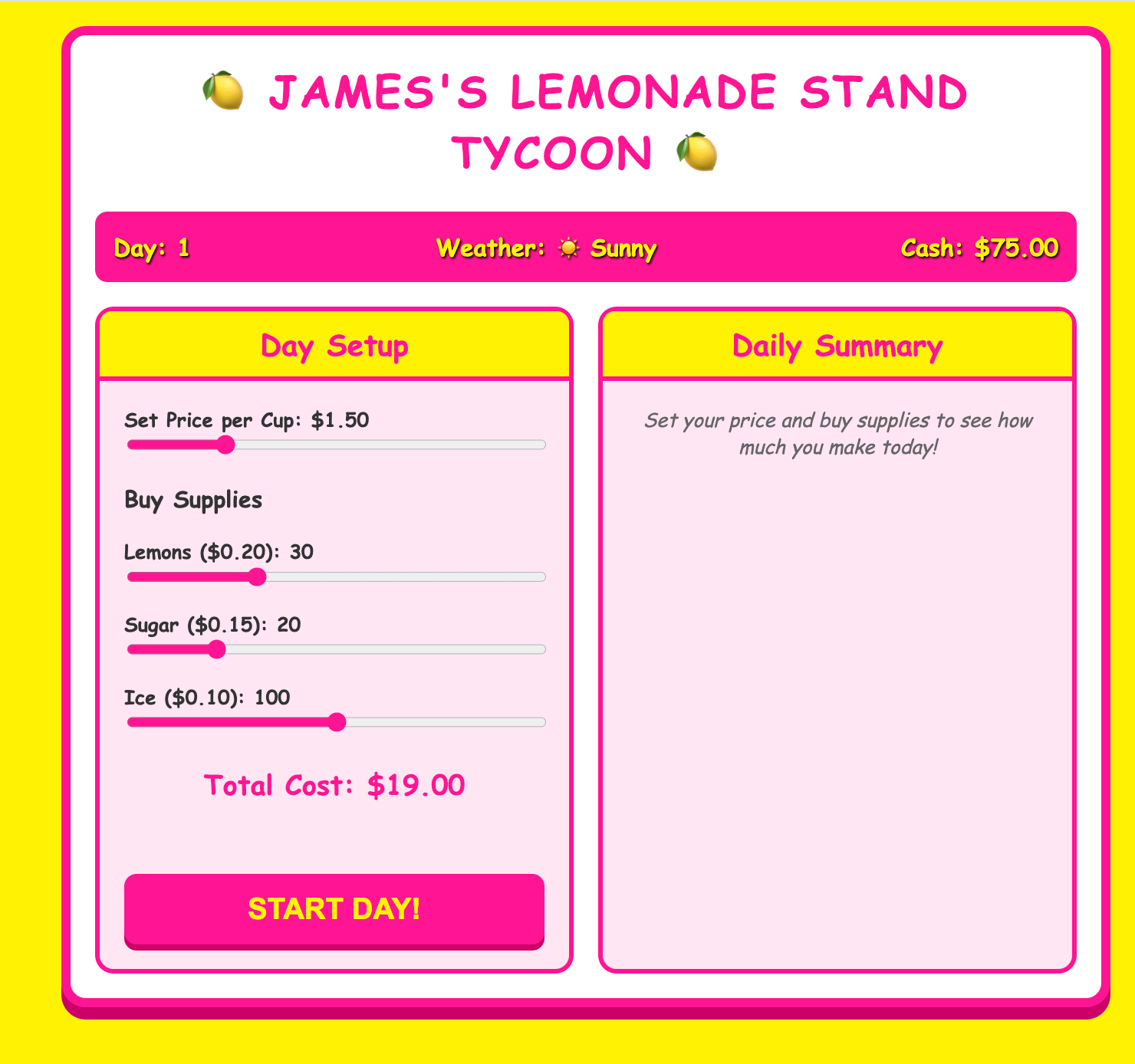
Remember Lemonade Stand? The green-screen one, where you set your price and a heat wave made you rich or a thunderstorm wiped you out by Day 4? My kid has never played it. One of the cards hands him a prompt that builds his own version, right there in the browser, where he sets the price, the weather turns on him, and at the end the AI quizzes him on what he’d have done differently. He thinks he’s playing the game his parents played. He’s actually learning supply, demand, and why a hot day is the best thing that can happen to a kid with a pitcher of lemonade.
That’s the whole trick of the deck. Every card is a Trojan horse.
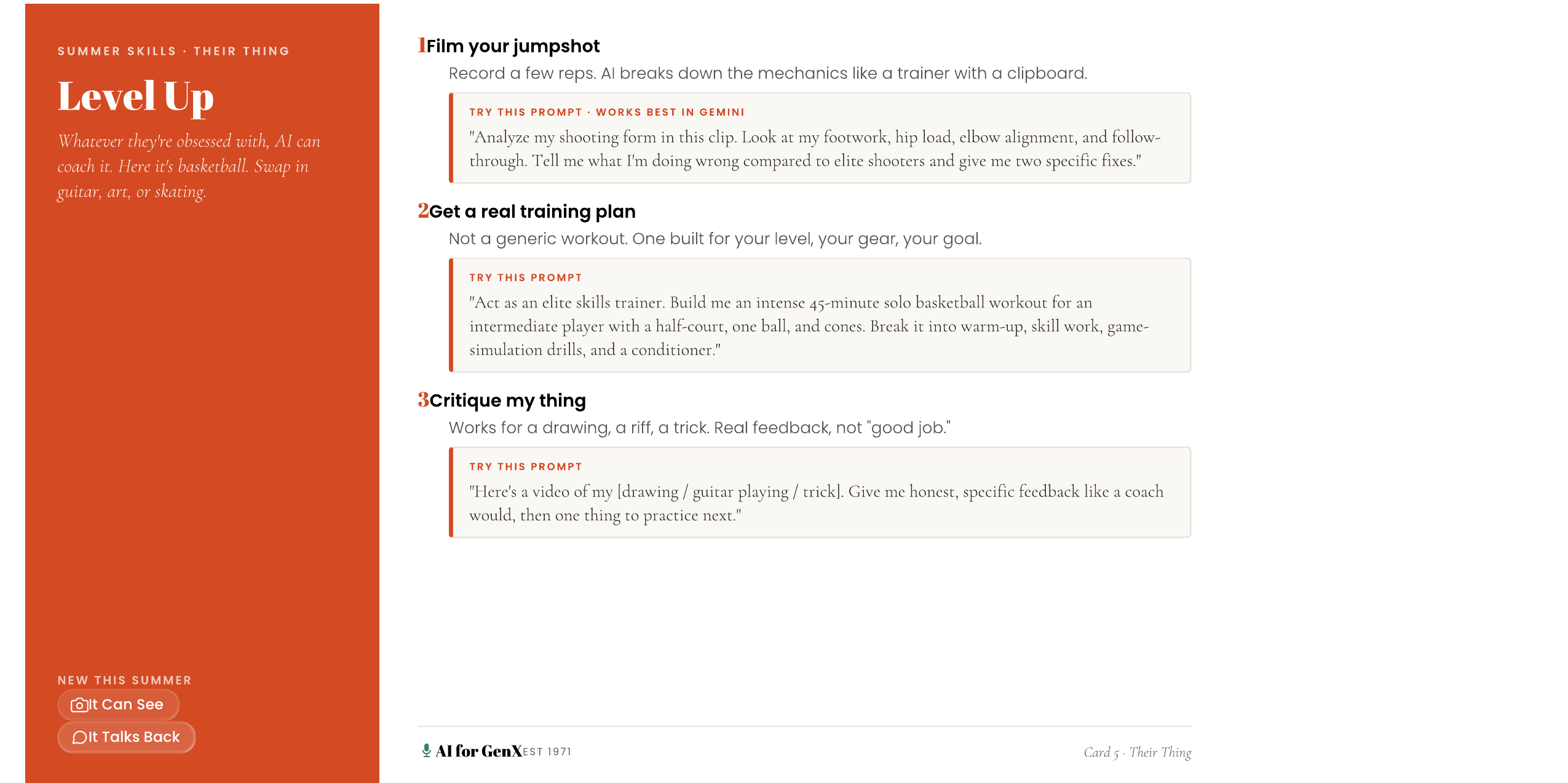
Because he lives for basketball, one card meets him right there. He films a few reps of his jumpshot and the AI breaks down his footwork, his elbow, his follow-through, like a trainer with a clipboard who actually watched the tape. It’ll build him a real training plan for his level and his half-court, not some generic workout off the internet. Guitar, drawing, skating, whatever your kid is obsessed with, the card swaps it in. The obsession becomes the curriculum.
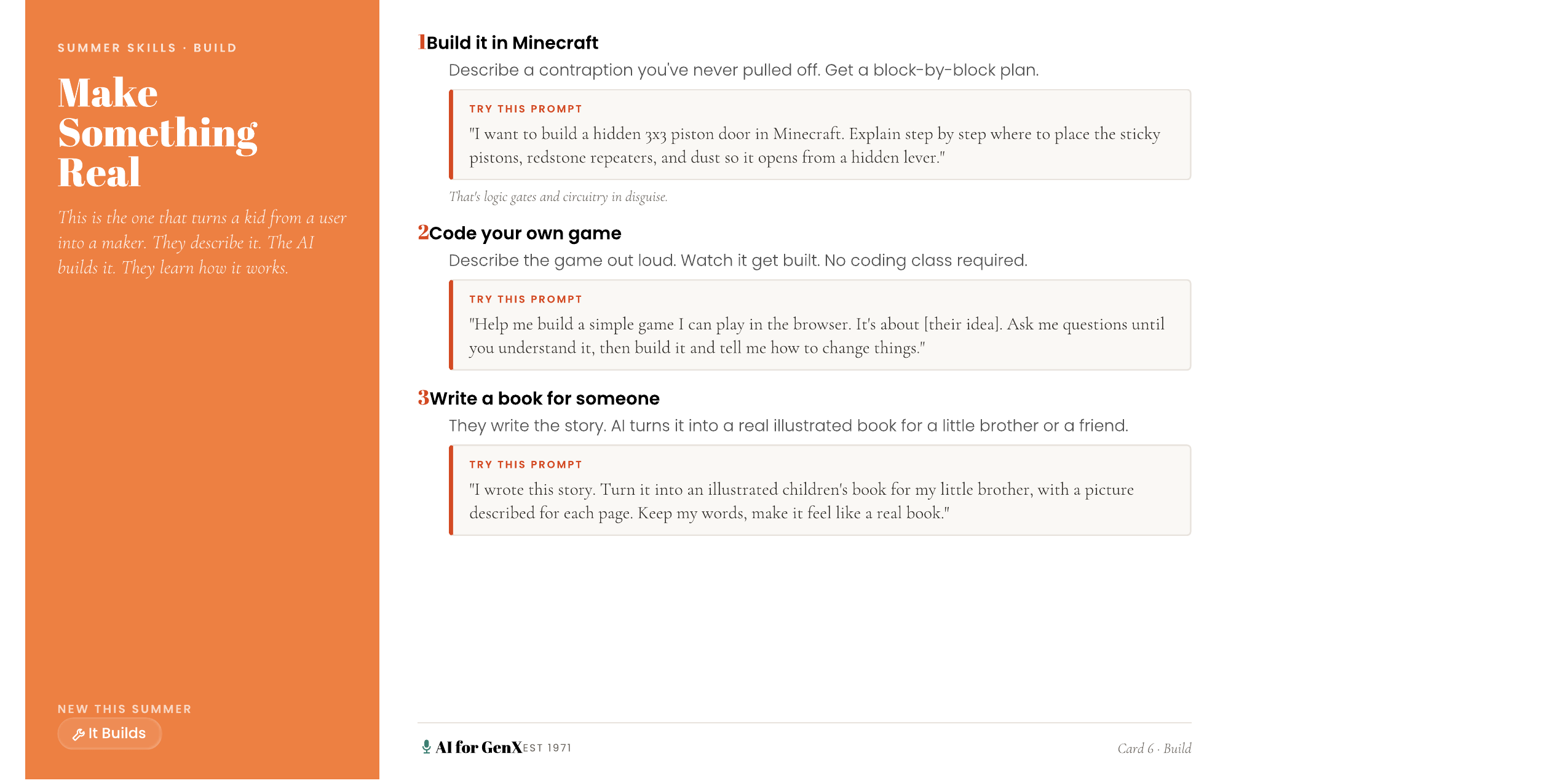
Then there’s the one that turns him from someone who uses AI into someone who builds with it. He describes a contraption he’s never managed to pull off, a hidden door in Minecraft that opens from a secret lever, and the AI walks him through it block by block. What he doesn’t realize is that he just spent his afternoon on logic gates and circuitry. Same card, he can describe a whole game out loud and watch it get built in front of him, no coding class required. Or take a story he wrote and have the AI turn it into a real illustrated book for a friend, his words kept exactly as he wrote them.
And there’s more where that came from. A card that turns a photo of the fridge into three dinners he can actually cook tonight. One where he practices for the first day at his new school by talking to a foreign exchange student from Uruguay who only speaks Spanish and is trying out for the same basketball team. One that quizzes him a little each day, remembers exactly what he keeps getting wrong, and circles back until it sticks.
Eight cards in all. The first one is just setup: five minutes telling the AI who your kid is, his age, his school, what he loves, what he’s working on, so every card after it actually knows him. The rest hit the categories that matter at 14: money, the kitchen, walking into a room where you know no one, getting better at the thing you love, building real stuff, getting unstuck on the hard problem, and keeping your own life from falling apart. Each comes with copy-and-paste prompts and a little tag showing which brand-new AI capability makes it possible this summer for the first time.
The cards come in two flavors. Some you hand straight to your kid. “Here, try this.” Others you make yourself with AI and then hand over, because “I made this for you” beats “go talk to the robot” every single time, for both of you.

The Parent’s Cheat Sheet
A few things I learned while building this that would have saved me time if someone had just told me upfront.
How the prompts actually work. Every card has a prompt in a colored box. You copy the text, open any AI tool (Claude, ChatGPT, Gemini), paste it in, and hit enter. That’s it. Some prompts say “copy, then make it yours” because you’ll want to swap in your kid’s name, their sport, their grade level. The prompt does the heavy lifting. You just personalize the details.
Not every AI is good at the same thing. I use Claude for almost everything, but for the cards, different tools genuinely shine in different spots. Gemini is the best at anything involving a camera or video, so the jumpshot card, the fridge photo? Start there. ChatGPT is the strongest at building things, so the Lemonade Stand game, the Minecraft walkthrough, coding a game from a description? That’s its lane. Claude is where I go when the quality of the conversation matters most, the tutoring cards, the new-school dry run, anything where nuance and patience make the difference. Each card works in any of the three, but if you want the best result, that’s your shortcut. If you are ever confused about tool use, for example how to kick off an actual verbal conversation or picking a model for the job, just ask the AI. Anytime you are confused, just ask.
The age rules are different for each one, and this matters. ChatGPT allows kids 13 and up with parental consent, and it has actual parental controls you can set up: linked accounts, quiet hours, content filters, the works. Gemini also starts at 13, and if you use Google Family Link you can give access to kids even younger with supervision built in. Claude requires users to be 18. No teen accounts, no exceptions. That means my 14-year-old can use ChatGPT and Gemini on his own, but for Claude, we sit together on my account. Honestly? That’s ended up being a feature, not a limitation. The cards I built in Claude are “I made this for you” cards by definition. I’m right there. And those have been the best ones.
What this actually costs. All three pro plans run about $20 a month. I’m paying for all three this summer, which is $60 a month. That’s less than a DAY of any camp or a few workbooks. The free tiers of all three are genuinely useful if you want to start there, but the paid versions give you faster responses, longer conversations, and access to the best models. Think of it as a summer investment. This is the year it’s worth trying. They will inevitably get more expensive next summer.
What’s Next
Next up, I’m building him a Life Skills Passport. A real, physical booklet he carries all summer, with stamps and challenges and quests built around his actual life: the new school, the basketball, the kitchen skills he very much does not have yet. I'm printing a real copy with Blurb, because some things should exist on paper even when AI helped you make them. Blurb isn't the only option either. There are several print-on-demand services that'll turn a PDF into an actual bound book for not much money.
This summer the workbook won’t sit there 75% empty. It won’t be a workbook at all.
Anyone who says AI kills creativity, frankly, isn’t being creative enough.
Every Prompt, Ready to Copy
If the prompts won’t copy out of the PDF on your device, they’re all right here. Tap into any of these, copy the text, and paste it straight into Claude, ChatGPT, or Gemini.
Card 1 · Train Your AI
“You’re helping my 14-year-old, James. He’s going into 9th grade at a new, competitive school this fall. He loves basketball and Minecraft. Strong reader, but math slipped this year and we’re rebuilding his confidence. Keep it encouraging, never babyish. When he’s stuck, coach him to the answer instead of handing it over. Talk to him like a sharp older cousin, not a teacher. We also want to build up his life skills. Think calendar, money management, cooking, cleaning, laundry. All the things needed to adult. We are working on fun ways to incorporate these skills into his summer.”\
Card 2 · Get the Bag
“Act as a tough but fair investor on Shark Tank. I’m 14 and my idea is [their idea]. Ask me hard questions about costs, profit, and who would actually buy this. Don’t let me off easy, then tell me if you’d invest and what I’d fix first.”
“I’m 14. Show me what happens if I save $20 a month starting now versus starting at 25. Use a simple chart and explain it like I’ve never heard the words ‘compound interest.’ Make the chart dynamic so I can change the amount or start date and see what happens.”
“Build me a Lemonade Stand game I can play in the browser. Let me set my price and supplies each day, change the weather randomly, then show my profit or loss. End the game after Day 7, turn my results into a short quiz: show me 2-3 ‘what if’ moments from my week and have me guess what would’ve happened if I’d priced or stocked differently before revealing the answer.”
Card 3 · Run the Kitchen
“Here’s a photo of our fridge and pantry. Give me 3 meals a 14-year-old can cook with just these, ranked easiest to hardest.”
“Plan a ‘cook the world’ summer. Each week, pick a new country, give me one real recipe a beginner can make, plus 3 quick facts about its food and history.”
“This recipe serves 4 and I’m cooking for 6. Rewrite every ingredient amount, and show the math so I learn how you did it.”
Card 4 · Hold Your Own
“Play a friendly kid I’ve never met at my new school. Start a normal conversation. Help me practice introducing myself and finding something in common.”
“You are a new foreign exchange student from Uruguay. You don’t speak English yet, but you want to try out for the basketball team. Let’s have a friendly conversation, in Spanish only, about the new school, the town, and the basketball team you’re hoping to join. Keep your Spanish at a Spanish 2 level, and if I seem stuck, slow down or rephrase more simply. Ask me questions too, so the conversation keeps going.”
“Here’s a clear photo of me in natural light. Based on my coloring, which clothing colors suit me best, and which should I skip? Keep it simple.”
Card 5 · Level Up
“Analyze my shooting form in this clip. Look at my footwork, hip load, elbow alignment, and follow-through. Tell me what I’m doing wrong compared to elite shooters and give me two specific fixes.”
“Act as an elite skills trainer. Build me an intense 45-minute solo basketball workout for an intermediate player with a half-court, one ball, and cones. Break it into warm-up, skill work, game-simulation drills, and a conditioner.”
“Here’s a video of my [drawing / guitar playing / trick]. Give me honest, specific feedback like a coach would, then one thing to practice next.”
Card 6 · Make Something Real
“I want to build a hidden 3x3 piston door in Minecraft. Explain step by step where to place the sticky pistons, redstone repeaters, and dust so it opens from a hidden lever.”
“Help me build a simple game I can play in the browser. It’s about [their idea]. Ask me questions until you understand it, then build it and tell me how to change things.”
“I wrote this story. Turn it into an illustrated children’s book for my little brother, with a picture described for each page. Keep my words, make it feel like a real book.”
Card 7 · Get Unstuck
“Here’s a math problem I’m stuck on. Don’t give me the answer. Ask me what my first step would be, then guide me one step at a time until I get it.”
“Give me 5 word problems about basketball stats that secretly teach me to solve for x. Make them feel like real games, not homework.”
“Be my summer math tutor. Quiz me a little each time, remember what I keep missing, and bring those topics back until I’ve got them.”
Card 8 · Get It Together
“Here’s a photo of my basketball schedule. Add these to my Google Calendar, then read them back so I can double-check every date and time.”
“Here’s everything I want to do this week: [list it all]. Build me a realistic day-by-day plan with time for fun, not just chores.”
“Build me a simple 6-step morning checklist so I can get ready on my own. Keep it quick, and let me earn something at the end of the week.”
If this is your First AI Summer too? I want to hear about it. Tell me which card your kid actually touched, not the one you wish they'd touch. Tag it #FirstAISummer so I can see what other families are building.
Every week I write an article or two related to AI that a GenX audience can relate to. I then turn this content into short video podcasts for anyone who just wants a debrief while they go out and “touch some grass.” My goal is to inform as I learn, too. You can find my podcast on YouTube, Spotify, and others. See my webpage aiforgenxpodcast.com for links to all my content, and thanks for following along and sharing with a friend! I’d love to hear how you are using it or what questions you have about it so please comment. I am a real person that lives in Tahoe and sometimes the forest trees just don’t talk back so it’s nice to get a conversation going even with a stranger.
We got this…
Well written. I definitely need more AI in my life to not only help with my family planning, but to help me as well. You offer up lots of great points.
I am going to try this for both kids and I will report back! I love this use of AI… much better than a boring workbook that kids just plug and chug misconceptions day after day.
This sentence really speaks to me: “Anyone who says AI kills creativity, frankly, isn’t being creative enough.” 🙌🏼❤️👏